Florida Puts Gold and Silver Back in Your Pocket
At a glance
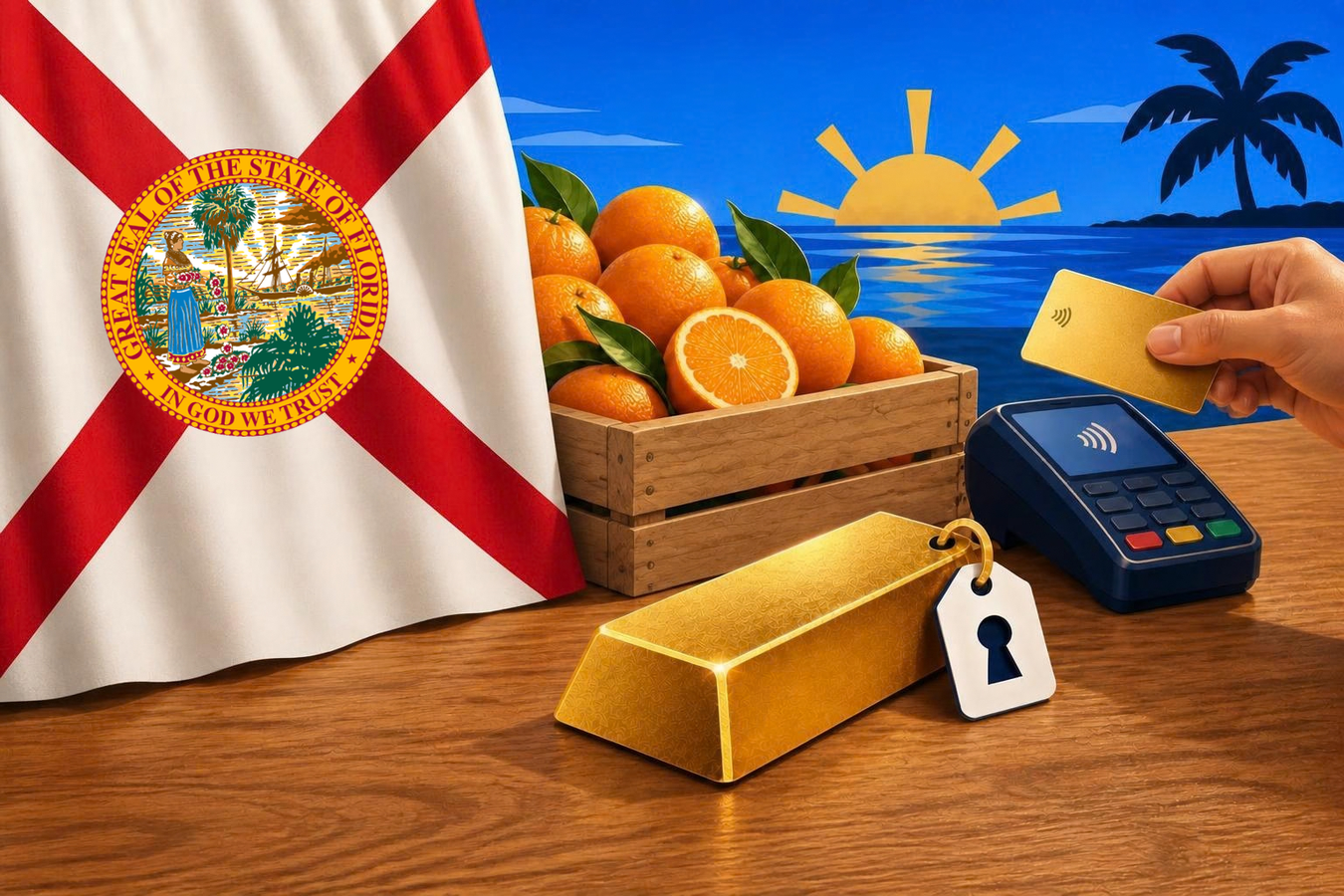
• Florida has made qualifying gold and silver legal tender and protected electronic payments with them, linking their legal status to everyday use.
• Florida is the first state to put the rules into effect: gold and silver payments became subject to them on July 1, 2026, and licensing for custodians is expected to open by year-end.
• No one is required to accept gold or silver, but state and local governments may now accept them electronically for taxes and fees.
• Companies that handle or transfer gold and silver for others as payment must be licensed, inspected, insured, and audited. Personal ownership rules remain unchanged.
• With more than 23 million residents, Florida gives the Constitution’s gold-and-silver clause its strongest practical footing in generations.
In January 1864, Lane County, Oregon, tried to pay its state tax bill in greenbacks. These were the paper dollars Washington had begun printing two years earlier to fund the Civil War. Congress had made them legal tender, but they could not be exchanged for gold or silver and traded well below face value. Oregon law required state taxes to be paid in gold and silver coin. The state treasurer refused the paper money, and Oregon took the county to court.
The case reached the U.S. Supreme Court, and Oregon won in 1869. Chief Justice Salmon Chase wrote that Congress’s paper-money laws did not apply to taxes imposed by a state. He added that the Constitution distinctly recognizes “the independent authority of the states” within their own sphere. It was a major victory for states’ rights and dual sovereignty, the principle that states keep their own powers alongside those of the federal government.
More than 150 years later, Florida has put the same idea into law and solved the issues that stopped earlier efforts. In 2011, Utah made federal gold and silver coins legal tender, but not much changed. For example, an American Eagle coin marked $50 is worth much more in metal, so people rarely spend them in stores, and the IRS still taxed them as collectibles. Money that can’t be used in daily life is only legal tender in name.
Florida’s law combines legal tender status with the ability to spend gold and silver by card, phone, or computer, just like most money today. When Governor Ron DeSantis signed the bill in May 2025, he said gold and silver “can start functioning like real currency again, not just investment vehicles for the wealthy.” Arkansas passed a similar law in April 2025, but Florida’s version is more detailed and is the first to be fully put into practice. Now that the country’s third largest state has made gold and silver both legal and usable, the Constitution’s gold-and-silver clause is no not simply a historical detail, it is now part of the system.
Why savers are paying attention
Inflation is built into the system. The Federal Reserve plans for prices to go up by 2% each year, which means they double in about 35 years - within one working lifetime. By the Fed’s preferred measure, inflation has run above 2% every month since March 2021, and it stood at 3.4% in August 2026.
Florida is affected by this more than most states. Over one in five Floridians - about 5.3 million people—are 65 or older, and many rely on savings and fixed incomes. They face two main risks: the slow loss of buying power and sudden financial crises. Gold and silver can help protect against both. Gold usually keeps its value over time, and unlike bonds, stocks or money in the bank, neither metal is anyone’s liability. Their value does not depend on a bank, a company or a government keeping a promise.
However, protection only matters if you can access it. Unexpected hospital bills, storm damage, or lost income put savings to the test. If you keep gold at home, you have to take it to a dealer and sell it, which takes time and costs money. But if your gold or silver is held electronically, you can spend it right away using a card or phone. Florida’s law is designed for this kind of quick payment.
“These precious metals can start functioning like real currency again, not just investment vehicles for the wealthy.”
Governor Ron DeSantis, signing HB 999, May 2025
What Florida’s law does
Starting July 1, 2026, gold that is at least 99.5% pure and silver that is at least 99.9% pure will be legal tender in Florida for debts incurred after that date. This covers rounds, bars, and coins marked only with their weight, purity, and refiner. By defining “coin” to include bars and rounds, the law addresses a limitation in Utah’s law: Florida gold and silver are valued by weight, not by a stamped face value. Government-minted coins, such as American Eagles, are excluded and retain their federal status. No one can be required to accept gold or silver unless they have agreed to do so in a contract, and banks and payment firms cannot be required to offer it.
This is what makes Florida’s legal tender function as money. The law says nothing in it may be read to “restrict the electronic transfer” of gold or silver as payment for a debt. It defines that transfer broadly as an instruction made “through debit card, mobile application, or computer” telling a bank or money services business to debit or credit an account with gold or silver, “or any fraction thereof,” or its equivalent in dollars “converted at current market price.” A card payment at a till qualifies. Bankson said this is what makes gold and silver “a truly functional currency.” It is also how gold and silver payments already work, and what Glint customers do today. They own allocated physical gold and silver, then spend the value of their gold by card, Apple Pay, or Google Pay, while the merchant is paid in dollars.
Card payments tell only half the story. With a card, the shop receives dollars. Legal tender status matters most when the person being paid wants the metal itself: a landlord, contractor, or relative settling a loan. In that case, gold or silver can move directly between accounts and settle the debt in metal. Florida has set rules for this, too: any business that transfers gold or silver between people as payment is a money transmitter and needs a license. Licensing opens later this year.
“With modern technology, you can spend it with a debit card, allowing for use for everyday transactions.”
Kevin Freeman, at the HB 999 signing, May 2025
Any business holding gold or silver whose ownership “is or may be transferred electronically” is treated as a money transmitter and must be licensed. This brings it under the rules that already apply to Florida’s payment firms, including federal anti-money-laundering requirements. Before issuing a license, the Office of Financial Regulation inspects the vault, which must be professionally rated, monitored around the clock, and built to withstand fire, floods, and hurricanes. The office then examines the custodian annually. The metal must be fully allocated, giving each customer a direct legal claim to their own share. It must be insured for its full replacement value, never lent or pledged, and audited at least once a year to verify that it covers every balance. Customers receive quarterly statements and clear disclosures about risks and fees.
For customers, that’s the point: protection against fraud and failure, with the kind of oversight people already expect from anyone handling their money. It gives savers good reason to trust gold and silver as something to spend, not just store.
Just as important is what the law leaves untouched. Individuals may still own gold or silver for their own use, which the law expressly excludes. A precious metals dealer that stores bullion for clients without transferring it between people as payment also falls outside the licensing requirement, since the license applies to the electronic transfer of ownership.
From law to working system
The law has a clear origin. State Representative Doug Bankson, a pastor from Apopka, took up the idea after receiving an early copy of Pirate Money, economist Kevin Freeman’s book about how states could make gold and silver usable as money again, and carried it to the governor’s desk. Freeman, host of Economic War Room, and his team have since worked with legislators across the country to advance what supporters call the sound money movement. In Florida, the idea drew bipartisan support. HB 999, co-sponsored by Representative Chip LaMarca, passed the House 112 to 1 and the Senate 38 to 0 in 2025. The follow-up bill that brought it into force passed 108 to 0 and 32 to 1 in 2026.
Florida did not simply pass a law and hope for the best. HB 999 included a self-repeal clause: if lawmakers failed to ratify a complete set of rules from the state’s financial regulators, the law would be repealed before taking effect. The regulators drafted rules covering record-keeping, customer disclosures, approved refiners, chain of custody, and how public money can be held in metal. Lawmakers ratified the rules in March 2026 and removed the self-repeal clause. The governor signed the bill on June 12, less than three weeks before it was set to take effect on July 1.
Other states are still developing rules, selecting providers, or waiting for funding. In Florida, custodian licensing is expected to open in the final months of 2026.
Size, standing and the limits of state power
Article I, Section 10 of the Constitution bars states from coining money or issuing paper currency, except that they may make gold and silver coins legal tender for debts. This is the only monetary power the Constitution leaves to the states, and no state has exercised it as fully as Florida.
Lane County still matters here. The Court recognized that a state may decide what it accepts for its own taxes. Florida’s choice to let its governments accept gold and silver fits squarely within that tradition of dual sovereignty.
“Within their proper spheres, the independent authority of the States is distinctly recognized.”
Chief Justice Salmon Chase, Lane County v. Oregon, 1869
There are limits, as history makes clear. When Congress acts within its powers, federal law prevails. In April 1933, President Franklin Roosevelt ordered Americans to surrender most of their gold coins, bullion, and gold certificates. Two years later, the Supreme Court upheld Congress’s authority to void clauses in private contracts that guaranteed payment in gold.
But size changes politics, and politics shapes what Washington attempts. DeSantis called Florida “the first large state to step up and to get this done,” and said he expected Washington to “clear the way” as more states act. A state with 23 million people, licensed custodians, audited vaults, and governments able to accept payment in metal creates facts on the ground. Supporters see Florida as a constitutional backstop. Any future federal government seeking to restrict gold and silver as money would have to reckon with millions of people in one of the country’s largest economies using them, and with a state that has already written their right to do so into law.
One barrier remains beyond any state’s reach: federal law still taxes gold and silver as collectibles, so spending metal that has increased in value can trigger a capital gains bill. Florida has no state income tax to add to it. And by making gold and silver both legal tender and spendable, its law gives the case for taxing them like money something Utah’s never had: everyday use.
In 1864, an Oregon county tried to pay the state in paper, but the state insisted on gold and silver. In 2026, Florida law allows governments to collect fees in gold or silver, paid with a tap of a card or phone. The Constitution’s clause was written for coins carried in a pocket. Now gold and silver are back in Floridians’ pockets. This time, traveling by phone and debit card.
For UK clients: At Glint, we make every effort to demonstrate a balanced conversation between gold, silver, crypto and fiat currencies when it comes to purchasing power and, while we strongly believe that gold is the fairest and most reliable currency on the planet, we need to point out that it isn’t 100% risk free. While we have seen a steady increase over time, the value of gold can fall, which means that its purchasing power can also decline.
For US clients: Graphic representations of value are for illustrative purposes only. The Glint debit card is issued by Sutton Bank, member FDIC. The sale, purchase and storage of precious metals are offered by Glint and not Sutton Bank. Your investment in precious metals through Glint is
• Not insured by the FDIC.
• Not a deposit or other obligation of, or guaranteed by, Sutton Bank.
• Subject to investment risks, including the possible risk of loss of the principal amount invested.
All investments involve risk, including possible loss of principal. The value of precious metals is affected by many economic factors, including but not limited to the current market price, demand, perceived scarcity, and quality of the precious metal. Precious metals can increase or decrease in value. Past performance is not a guarantee of future results. As such, investing in precious metals may not be suitable for everyone.
Sources
• Florida Senate, HB 999 (2025), bill history and votes
• Florida House of Representatives, Final Bill Analysis, CS/HB 999 (2025)
• Florida Senate, HB 1311 (2026), bill history and votes
• Florida House of Representatives, Final Bill Analysis, CS/CS/HB 1311 (2026)
• Governor Ron DeSantis, HB 999 bill signing press conference, Apopka, Florida, May 27, 2025
• Florida Statutes, Section 215.986, gold and silver coin as legal tender
• Florida Statutes, Section 560.103, definitions
• Florida Statutes, Section 560.214, custodians of gold and silver coin
• Florida Statutes, Section 560.1235, anti-money laundering requirements
• Florida Administrative Code, Chapter 69V-560
• Utah Legislature, HB 317 (2011), Currency Amendments (Legal Tender Act)
• US Supreme Court, Lane County v. Oregon, 74 U.S. 71
• American Presidency Project, Executive Order 6102 (1933)
• US Supreme Court, Norman v. Baltimore & Ohio Railroad Co., 294 U.S. 240 (1935)
• National Archives, US Constitution transcript
• Federal Reserve, Statement on Longer-Run Goals and Monetary Policy Strategy
• US Bureau of Economic Analysis, PCE price index (via FRED)
• US Census Bureau, QuickFacts: Florida