Gold has a global price, Physical gold has an address

What really sets the price of physical gold and silver: form, location, and the cost of moving between them.
At a glance:
The quoted “spot price' for gold or silver refers to the international wholesale market benchmark. The cost of actual physical metal also depends on its form, location, and current availability.
Coins and small bars usually have a higher cost per ounce than large wholesale bars due to increased fabrication, handling, and distribution efforts.
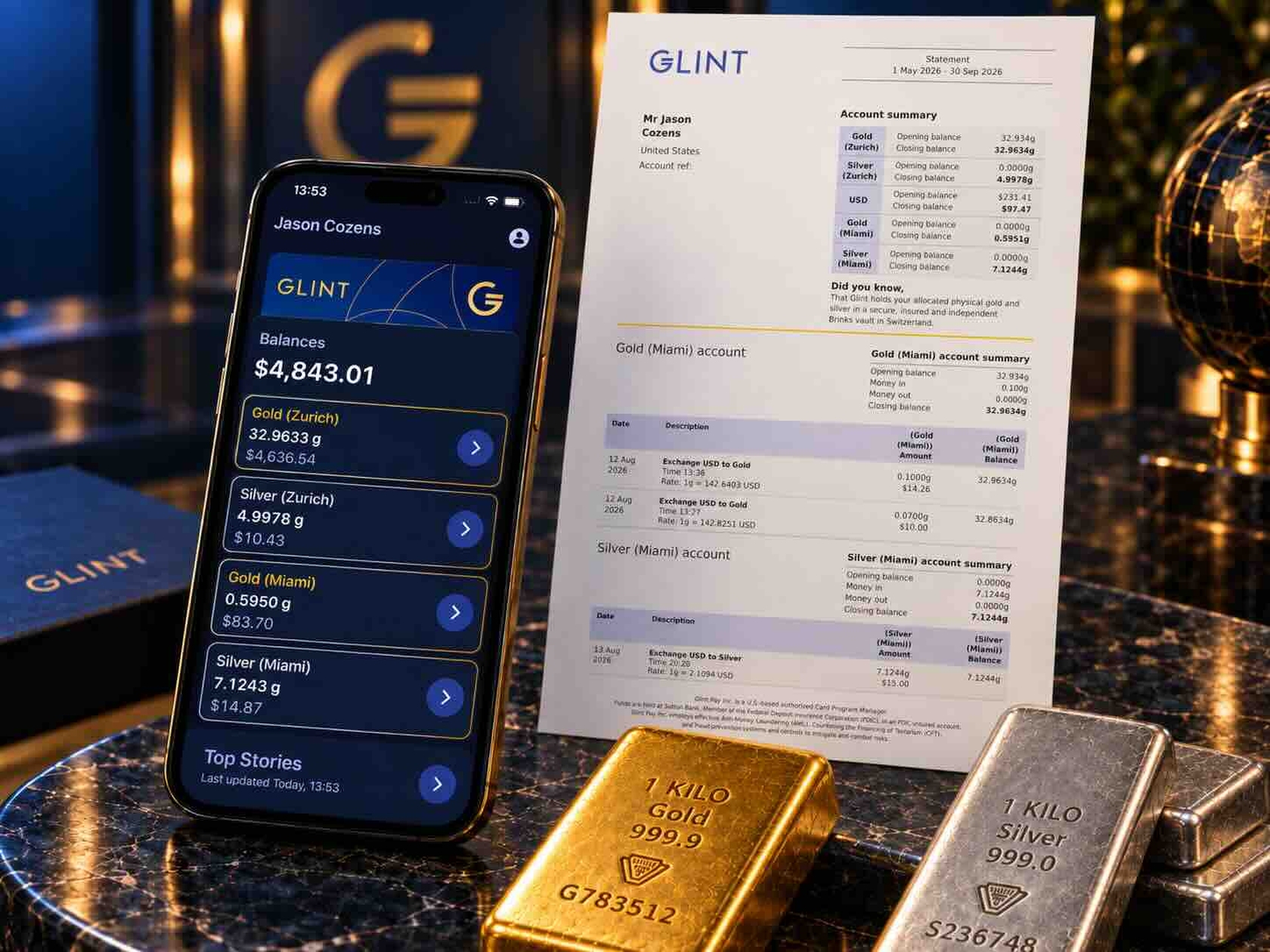
Location also plays a role. Glint’s prices in Miami and Zurich may vary because each vault operates within its local market of supply and demand. Under typical market conditions, this difference is minimal - less than 0.01% as of now - and can fluctuate in either direction.
Open the Glint app, and you might see that the wholesale gold price in Miami can differ slightly from the price in Zurich. The same applies to silver. Our US metals are stored with Brink’s in Miami; the reason for choosing Florida for our first US vault is a different story and will be covered in a different article.
The difference is usually minimal - less than 0.01% at the time of writing - because bullion can be moved between markets. So why does any difference exist at all? The answer starts with understanding what we truly mean by “the gold price”.
What is the gold spot price?
If you check the gold price online, you'll usually find a single figure known as the spot price. Although this number is useful, it needs some context for better understanding. In the professional bullion market, dealers don't trade at a single universal price. Instead, they provide two quotes: a bid price, which is what they pay when buying gold, and an offer or ask price, which is the price they ask when selling.
When a financial website displays a single live “spot price”, it typically represents an indicative price taken from the wholesale market - usually near the midpoint between bid and offer. While this serves as a helpful reference, it should not be mistaken for a firm offer to sell any amount or type of physical precious metal at that precise price. See What price do you pay with Glint?
Another key detail is worth noting.
The main international OTC (Over-The Counter) standard for physical gold is Loco London. This means the typical wholesale spot price is based on gold settled in London. Usually, spot trades settle two business days after execution.
The specific form of gold also matters. London wholesale transactions involve bars typically weighing 12.5 kg or 1kg.
When you see a gold spot price displayed, it doesn't mean anyone can buy a one-ounce coin, a 1kg bar in Miami, or a small bar in Zurich at that exact price. This figure is a reference point for wholesale markets. A helpful way to understand physical bullion pricing is to consider it as:
Usually, these adjustments are small, but occasionally they can be more significant.
Why gold coins and small bars cost more
Convert a 400oz wholesale gold bar into hundreds of smaller bars or coins. The total gold amount remains the same, but the process involves additional work. Producing the metal involves melting, dividing into accurate weights, minting or casting, testing, stamping, handling, and distributing. As the product size decreases, these costs generally increase in proportion to the amount of gold contained.
The US Mint offers a helpful illustration, but it’s important to distinguish between bullion coins and collector coins. The Mint doesn’t sell its standard American Eagle bullion coins directly to the public. Instead, large-scale authorized purchasers buy them in bulk, with a minimum gold order of 1,000 ounces.
Wholesale purchasers are charged the LBMA PM Gold Price plus a 3% premium for a one-ounce American Gold Eagle by the Mint. This premium increases to 5% for a half-ounce coin, 7% for a quarter-ounce, and 9% for a tenth-ounce coin.
These are wholesale premiums; retail customers will pay different prices, as dealers and distributors have their own costs and margins. Collector versions can be significantly more expensive.
Currently, the US Mint was selling its limited-edition 2025 One Ounce Gold Uncirculated Coin for approximately $5,270. With a gold price of about $4,353 per ounce, this price is roughly 21% higher than the intrinsic value of its one ounce of fine gold. (US Mint product pricing policy)
It would be misleading to see the entire difference as just the cost of converting wholesale gold into a one-ounce coin. The uncirculated Eagle is a collector's item, featuring a limited mintage, special finish, mint mark, presentation case, and certificate of authenticity. Part of its price accounts for these features rather than gold alone. A more meaningful comparison is the Mint’s published wholesale premiums: even before dealer costs are included, the premium increases from 3% for a one-ounce coin to 9% for a one-tenth-ounce coin.
The core idea is simple: an ounce of gold remains an ounce of gold, but its associated product can vary greatly in price. Although Glint does not currently sell small bars and coins (only through redemption) we still see that they serve a purpose; at Glint, we see value in holding some physical gold yourself. Coins and small bars provide direct, tangible access to a globally recognized store of wealth. However, this convenience incurs a price.
For gold bought and stored with Glint, the objective is different. We aim to deliver allocated physical ownership efficiently while enabling that gold's value to function as money. This is why Glint mainly employs 1kg and 400oz institutional bars, as larger wholesale formats typically reduce fabrication premiums compared to smaller retail products.
If your goal is to save in gold on a large scale, it makes sense for most of your funds to be invested directly in gold.
Why physical gold prices differ by location
Imagine a buyer in the United States needs a 1kg gold bar and an equivalent amount of gold is located in Zurich. This requires moving the gold, which involves secure transportation, insurance, handling, financing, customs clearance, and time. Sometimes, bullion must also be converted into a different form to meet the specifications of another market.
Local supply and demand are also important. If US buyers suddenly need more physical gold and the available metal is elsewhere (e.g. Europe or Asia), gold in America can fetch a higher price. Conversely, if American vaults are well stocked but demand is highest elsewhere, gold in America might trade at a discount.
Professional bullion-market participants consistently take advantage of significant price differences across locations. When gold becomes notably cheaper in one market compared to another, they are motivated to buy in the cheaper market and transfer or hedge the metal into the more costly one. This process, known as arbitrage, is a key reason why wholesale gold prices worldwide tend to stay closely aligned.
What does the Miami-Zurich difference mean on $1,000?
At the time of writing on 10 September 2026, the price to buy 1g of gold with US dollars through Glint was:
Miami: $140.1448 per gram
Zurich: $140.1578 per gram
The price difference was only 1.3 cents per gram, or roughly 0.0093%. On this occasion, Miami was cheaper, but on another day, it could be more expensive. To see this more clearly, consider a $1,000 purchase. At the Miami rate, $1,000 equals about 7.13548 grams of gold; at Zurich’s rate, it equals around 7.13482 grams. The difference amounts to approximately 0.00066 grams of gold, which is worth about nine cents at those prices.
This comparison highlights the difference in the quoted gold price; however, the relevant Glint fee (which does not fluctuate) should also be considered when purchasing. While location can influence prices, under typical market conditions, efficient global markets and arbitrage tend to make this impact negligible. It is primarily during market stress that these adjustments become significant.
COVID and the cost of getting gold to the right place
In March 2020, the global bullion market infrastructure experienced disruption. Passenger flights were significantly reduced, and major Swiss refineries temporarily shut down. As a result, transporting suitable gold into New York became much more difficult. However, gold did not vanish globally; the issue was about delivering the correct form of gold to the appropriate location at the right moment.
The price indicated the difficulty involved. LBMA research shows that the gold Exchange for Physical - a metric linking London physical gold and New York futures - briefly climbed to about $70 per ounce in early April 2020. Silver’s similar spread exceeded 60 cents at times, compared to the usual range of approximately 1–10 cents. source
As refineries resumed operations and transportation improved, metal supplies moved toward the higher-priced market, reducing the price gap once more.
The 2025 gold tariff scare
A new kind of friction emerged in 2025. Concerns had been growing since early in the year as the Trump administration’s tariff plans took shape, leading traders to consider the possibility that some gold bars imported into the U.S. might face tariffs. The pivotal moment came with a US Customs and Border Protection classification decision on July 31, 2025, regarding 1kg and 100oz cast gold bars from Switzerland. The ruling assigned a tariff code that suggested the potential for country-specific duties (see the CBP ruling from the CROSS database).
The announcement was not about a new gold tariff, but markets quickly began pricing in the potential that importing widely traded bullion into the United States might become significantly more costly. Gold futures in New York surged sharply compared to the spot price before President Trump clarified on August 11 that imported gold would not be subjected to tariffs. Subsequently, the spread between futures and spot prices narrowed.
The episode illustrated an important principle: markets not only price existing friction but also anticipate potential friction.
Then silver went the other way
Later in 2025, Silver presented an even more remarkable example. Concerns about tariffs earlier in the year led to significant amounts of silver being transferred from London to CME-approved warehouses in the US. According to the World Silver Survey 2026, US silver bullion imports hit a quarterly high of 91.1 million ounces in the first quarter of 2025, with a large portion coming from the UK and being shipped by air. (Source: The Silver Institute, World Silver Survey )
By October 2025, London faced a severe liquidity shortage. Inventories shrank just as demand rose, boosting the value of silver available for immediate delivery in London. Metal started flowing back across the Atlantic. While global supply figures are important, the key factor for the immediate physical price is the amount of suitable metal available where it is actually needed.
A shortage of coins is not necessarily a shortage of gold
This distinction is important at the retail level as well. If a dealer temporarily runs out of one-ounce coins during a surge in demand, it doesn't mean that gold or silver is unavailable overall. Instead, there might be plenty of wholesale bullion stored in institutional vaults, while mints and refiners struggle to produce smaller coins quickly enough. This can lead to significantly higher premiums on coins and small bars, even though wholesale metal is still accessible. Essentially, it reflects a shortage of a specific product form rather than a shortage of the actual metal.
What price do you pay with Glint?
While the Glint chart area displays a benchmark price, when you purchase or sell gold or silver via Glint, the app displays a wholesale market price that is constantly updated to reflect market fluctuations. This price is displayed again when you are asked to confirm your transaction. Since physical metals stored in various locations are part of separate local supply and demand pools, the wholesale prices in places like Miami and Zurich may sometimes differ, as illustrated in our earlier example. The basic idea for customers is straightforward:
The price you pay is the wholesale market price shown in the Glint app, plus the applicable Glint fee.
Glint’s use of large wholesale bars means you avoid purchasing retail coins or small bars that include the extra fabrication premium tied to that specific product.
Most days, the processes behind physical gold pricing are nearly invisible. Occasionally, events like a pandemic, a tariff scare, or a shortage remind us of their presence. While gold has a global price, physical gold involves a specific form, location, and the costs to transfer it.
Footnote: Depending on your tax jurisdiction and personal circumstances, some government-issued coins may be exempt from Capital Gains Tax (CGT).
For UK clients: At Glint, we make every effort to demonstrate a balanced conversation between gold, silver, crypto and fiat currencies when it comes to purchasing power and, while we strongly believe that gold is the fairest and most reliable currency on the planet, we need to point out that it isn’t 100% risk free. While we have seen a steady increase over time, the value of gold can fall, which means that its purchasing power can also decline.
For US clients: Graphic representations of value are for illustrative purposes only. The Glint debit card is issued by Sutton Bank, member FDIC. The sale, purchase and storage of precious metals are offered by Glint and not Sutton Bank. Your investment in precious metals through Glint is
Not insured by the FDIC.
Not a deposit or other obligation of, or guaranteed by, Sutton Bank.
Subject to investment risks, including the possible risk of loss of the principal amount invested.
All investments involve risk, including possible loss of principal. The value of precious metals is affected by many economic factors, including but not limited to the current market price, demand, perceived scarcity, and quality of the precious metal. Precious metals can increase or decrease in value. Past performance is not a guarantee of future results. As such, investing in precious metals may not be suitable for everyone.