Adding fuel to the fire: How US debt and rising yields could affect your mortgage
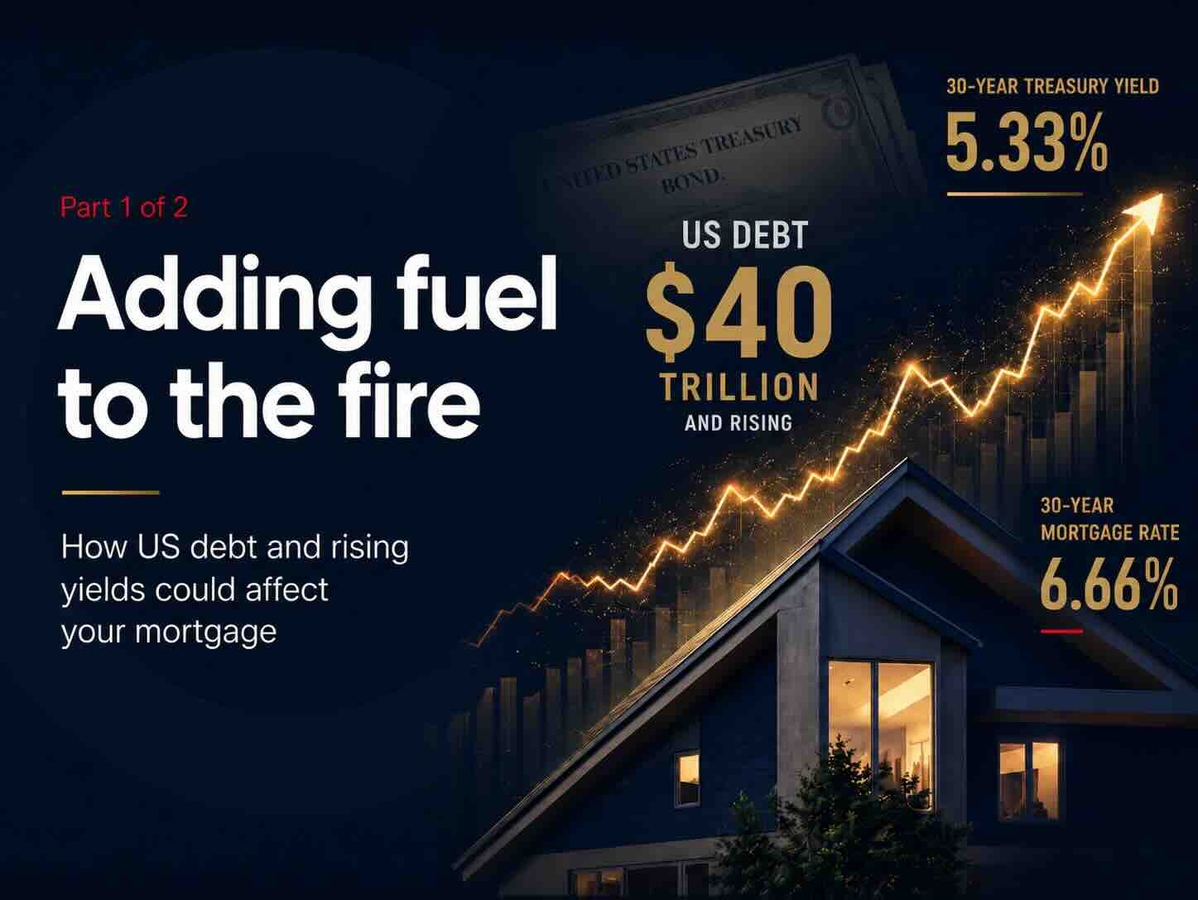
This is the first part of a two-part series.
This year, the US government has to refinance about $10 trillion in debt, and the new interest rates are much higher than before.
The interest the US pays on its national debt already exceeds its defense spending, and the CBO expects this cost to double by 2036.
These costs affect more than just the government. They lead to higher mortgage rates and can reduce the value of your savings.
On August 18, the yield on the 30-year US Treasury hit 5.33%, the highest since 2007. The following day, US national debt passed $40 trillion for the first time.
Most people will not see these numbers on their bank statements, but they still affect your daily life - through things like mortgages, rent, shopping, and even voting decisions.
Here’s why:
The ten trillion dollar year
$40 trillion is a huge number, but it’s not the most important one right now.
In the next year, the US government needs to refinance about $10 trillion in debt, according to Torsten Slok, chief economist at Apollo. This is on top of a deficit that’s already close to $2 trillion.
Refinancing is normal for governments. The challenge now is doing it with today’s higher rates.
Think about a mortgage: if your old rate was 2% and the new one is 5%, nothing about your house or income has changed, but your debt now costs more.
This is what’s happening to the federal budget, as each bond matures: If $10 trillion is refinanced at just one percentage point higher, that’s about $100 billion more in interest each year. Two points means $200 billion. And this cycle keeps repeating, since the debt keeps coming due..
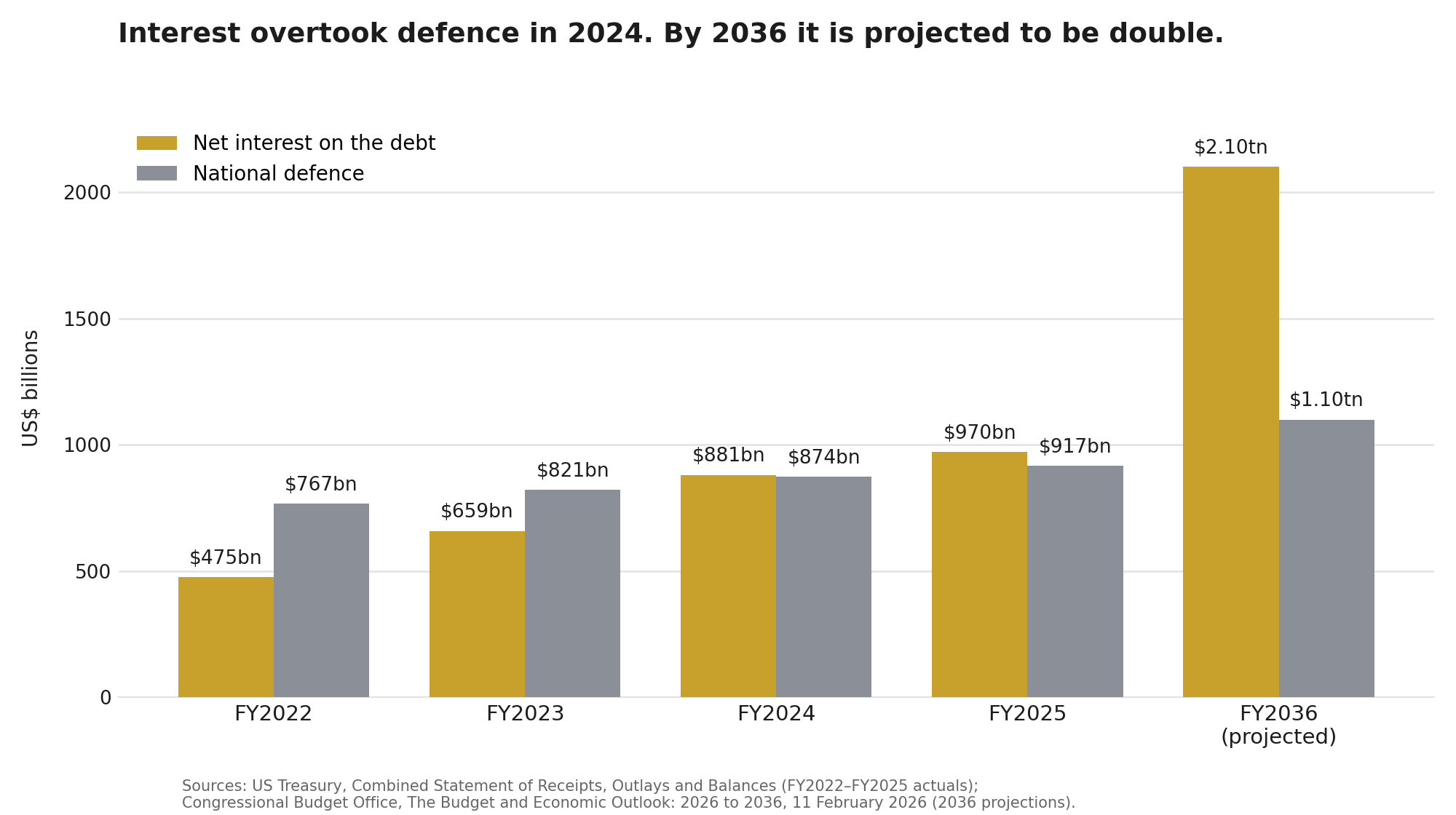
Net interest on the US national debt versus national defense spending, FY2022–FY2025 actuals with Congressional Budget Office projections to 2036.
The US already pays about $1 trillion a year in interest. In 2024, interest payments became larger than defense spending, and its continuing to increase. The CBO expects interest costs to reach $2.1 trillion by 2036, about twice what’s projected for defense.
This compounding effect is clear in budget forecasts. The CBO expects the primary deficit (before interest payments) to shrink a bit over the next decade, from 2.6% to 2.1% of GDP. But the total deficit will still grow, from 5.8% to 6.7%. The difference is interest. Even if Washington improves its direct spending, rising interest costs wipe out those gains.
The Government’s own Accountability Office estimates that publicly held debt will rise from about 101% of GDP now to 123% by 2036 and to 251% by 2056. Both call this path unsustainable. That doesn’t mean the US will run out of money, but it does mean things can’t go on like this forever.
Jamie Dimon, JP Morgan’s CEO, has raised similar concerns. In April, when asked if he was worried about government debt, he said that if things continue as they are, there could be “some kind of bond crisis.” He added that it’s better to address the issue now than wait for a crisis.
What it costs you
As of the week ending August 27, the average 30-year US mortgage rate was 6.66%, according to Freddie Mac.
Treasury borrowing isn’t the only factor. Mortgage rates follow the long-term bond yields, which are influenced by inflation expectations and the amount of government debt in the market. Lawrence Yun, chief economist at the National Association of Realtors, explained last month that higher inflation and higher long-term borrowing costs mean higher mortgage rates, no matter what the Federal Reserve does with its policy rate.
It helps to look at real numbers, because a single percentage point seems small until you see how it affects your mortgage balance!
The average outstanding US mortgage balance was $264,162 in March 2026 ($457,540 in California!). At 6.66% over thirty years, that comes to about $1,698 a month in principal and interest, or about $2,100 once property taxes and insurance are added. Of that payment, roughly $1,466 is interest in the first month. The borrower is paying far more for the money than they are paying off the house.
If the rate goes up by one percentage point, the monthly payment jumps to $1,876 which is $179 more each month, or about $2,150 more per year. Over the life of the loan, that extra point adds up to $64,264 in additional interest.
A one-point increase in government borrowing cost means about $100 billion more in federal interest each year. For an average household, one point means $64,000 more over a lifetime. It’s the same percentage point, moving through the same bond market, but for households, it’s very personal.
That’s the real reason bond yields really matter, even if you’ve never bought a bond yourself.
The harder problem is political
The math suggests clear solutions for consideration: spend less, maybe tax more, or do both. The real challenge isn’t economic, it’s political.
Tough fiscal discipline means incurring visible costs now for benefits that won’t materialize for years. Borrowing does the opposite - it gives us something right away and pushes the cost into the future. This isn’t just a problem for any one political party. Tax cuts and new spending are easier to promise to the electorate than the restraint needed to pay for them. That’s why deficits have persisted under both parties, and why the government’s finances haven’t returned to normal after the pandemic programs ended.
Jessica Riedl of the Brookings Institution put the voter side of it precisely this month: “We can blame politicians, but very few voters will back up their deficit concerns” with any real willingness to accept higher taxes or smaller benefits.
The cycle continues: when inflation makes everything more expensive. People feel the pressure and understandably want relief, but providing relief costs money. Government spending is the problem, but the solution offered is often even more spending.
This isn’t to say support programs are necessarily bad. It’s just about the incentives at play. When borrowing more seems like the easiest fix for problems caused by borrowing, it’s hard to argue for restraint. That leaves politicians with tough choices they’d rather avoid if they want to get re-elected.
These choices will get even tougher in the early 2030s. According to the 2026 Social Security Trustees Report, the US government Social Security Trust Fund will run out of reserves in late 2032! After that, payroll taxes will only cover about 78% of promised benefits. Benefits won’t vanish, but someone will have to decide who takes the hit for the missing 22%. This will happen just as interest payments are taking up the biggest share of the budget, with both needs competing for the same tax dollars.
What will those dollars buy?
The US can always create more dollars, since it issues the world’s reserve currency. Unlike a household, it can’t run out of money. When debts become too hard to manage politically, the US government has the exorbitant privilege of simply printing more dollars.
So the real question isn’t whether Washington can pay its bills, but what those dollars will actually buy.
Inflation is a quiet way for a government to default when it borrows in its own currency. The government keeps its promises in the name, but the money it repays is worth less. Since 1970, the Pound has lost about 95% of its value, and the Dollar hasn’t done much better!
The US doesn’t have to default for its debt problem to affect you. Your money will just continue to lose value.
This brings up a common question: if gold is the answer, what happens when interest rates go up and gold doesn’t pay any interest? Part two will take a closer look at that argument.
For UK clients: At Glint, we make every effort to demonstrate a balanced conversation between gold, silver, crypto and fiat currencies when it comes to purchasing power and, while we strongly believe that gold is the fairest and most reliable currency on the planet, we need to point out that it isn’t 100% risk free. While we have seen a steady increase over time, the value of gold can fall, which means that its purchasing power can also decline.
For US clients: Graphic representations of value are for illustrative purposes only. The Glint debit card is issued by Sutton Bank, member FDIC. The sale, purchase and storage of precious metals are offered by Glint and not Sutton Bank. Your investment in precious metals through Glint is
Not insured by the FDIC.
Not a deposit or other obligation of, or guaranteed by, Sutton Bank.
Subject to investment risks, including the possible risk of loss of the principal amount invested.
All investments involve risk, including possible loss of principal. The value of precious metals is affected by many economic factors, including but not limited to the current market price, demand, perceived scarcity, and quality of the precious metal. Precious metals can increase or decrease in value. Past performance is not a guarantee of future results. As such, investing in precious metals may not be suitable for everyone.