In the shadows

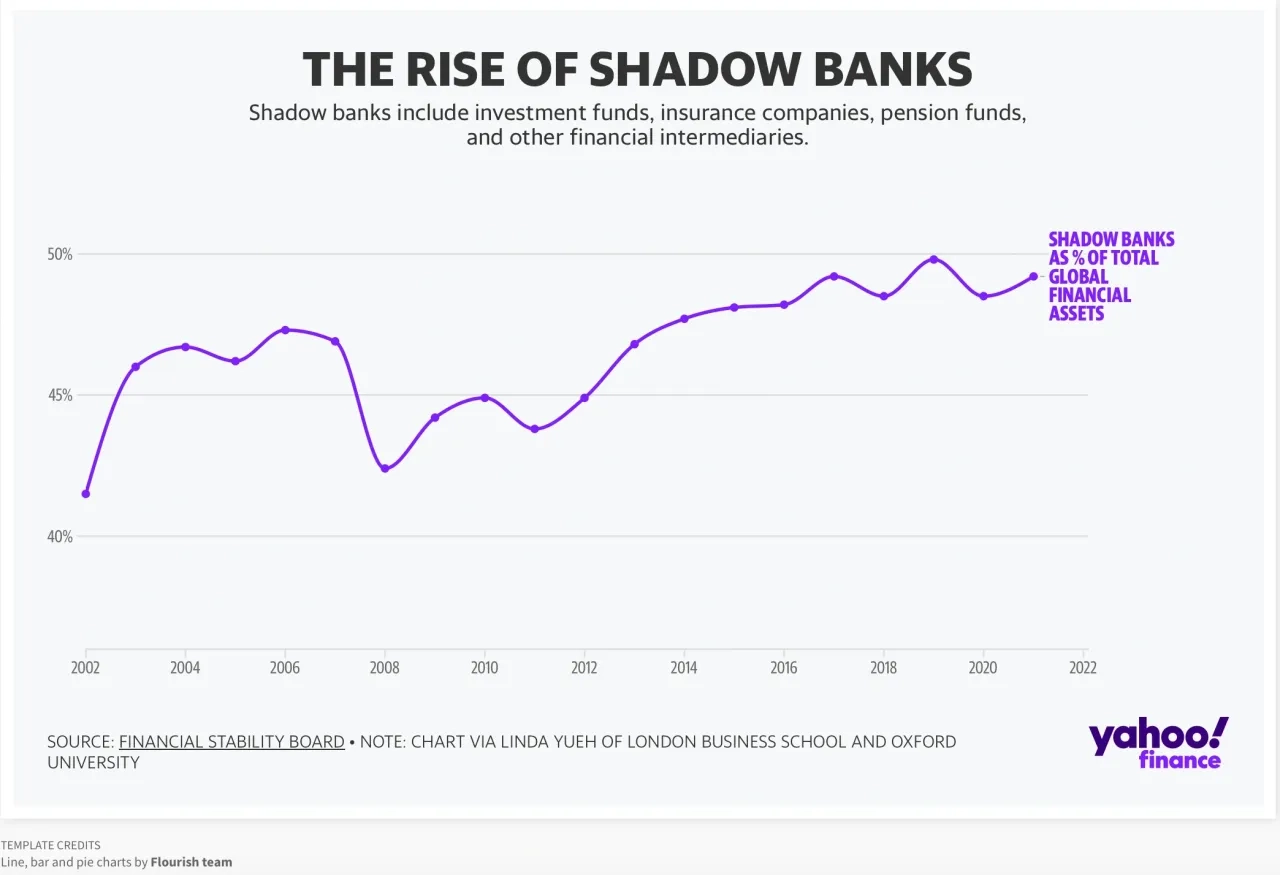
It's been 18 years since the Great Financial Crash (GFC). In those years, the global shadow banking system has expanded from around $28 trillion to more than $250 trillion. That's around half of all global financial assets.
The rapid expansion of this non-bank financial system - shadow banks - has started to trouble all major international financial organizations. One such is the Financial Stability Board (FSB), established in 2009 as one of the regulatory bodies established to safeguard us from another financial catastrophe.
At the end of 2024 the FSB said that only $76.3 trillion - about 15.4% of total global financial assets might create bank-like financial stability risks.
So rest easy?
These agencies argue that non-banking credit boom strongly reminds them of the imbalances that led to the GFC - more leverage, opacity in investments, reliance on private credit ratings, and a strong linkage between banks and non-banks. One such agency, the G30, recently published a report on the risks involved in this credit boom. Titled, "Nonbank Financial Intermediation and Financial Stability: A Perfect Storm in the Making?" it talks of 'new vulnerabilities and systemic risks'.
How has this emerged?
It's one of the consequences of the GFC. Governments decided blame for the GFC should rest at the doors of banks. So they drastically tightened banking regulations. But that didn't halt the craving for credit.
All kinds of entity rapidly developed to provide that credit, many of them borrowing money from banks,which they then lent. These entities - such as hedge funds or finance companies - act like banks but are not banks. They sit outside banking regulations. They are part of the 'shadow' banking system.
Fragmenting the risks
Shadow banking is not called 'shadow' for any murky reason. Financial professionals prefer to call it 'non-banking financial intermediation' or NBFI, 'intermediation' being a fancy word for connecting savers and borrowers.
Some NBFIs, such as pension funds or insurance companies, are regulated. The trouble is the rules change, between countries and types of firms.
But while the banking sector - already very globalised - has become much more tightly and universally regulated since the GFC, the NBFI sector has exploded, to feed the credit demand.
And as credit suppliers have mutated and vastly increased in number, so too have the risks.
Rather than the simple risk in banking - lending too much and being caught short so that depositors can't withdraw their cash - the risks from shadow banking are complex, multiple. Rather like Mickey Mouse as the Sorcerer's Apprentice in Disney's Fantasia, who looks like drowning amid the mess he has created, individuals are now surrounded by what seems like chaos.
During a period of financial stress a NBFI could find the bank who lent it money suddenly needs to recover that loan. If that stress affects more banks, the single stress for one NBFI might turn into a wider problem. The individual risk can expand and become a systemic risk.
There may well be no single homogeneous regulatory authority overseeing such a risk - which of course could threaten not just the NBFI sector but banking too.
No systemic crises have yet arisen but several individual cases - such as the collapse of the highly leveraged Archegos family office in 2021 - show how one non-bank can inflict multi-billion losses for regulated global banks. Credit Suisse lost about $5.5 billion after Archegos failed to meet margin calls to the bank.
Protect yourself
We all need a way of being able to receive and pay money without the worry of wondering if the transactions actually happen.
We don't want the kind of stress that can be caused by the failure of an Archegos, of whom few had even heard of until it hit the headlines in 2021. Since the GFC most consumers are protected against bank failures by various regulatory bodies, but only up to certain limits.
We don't want to see another Archegos, let alone another GFC. But as shadow banking has grown like Topsy and will continue doing so, the risks involved in feeding the credit craving will only increase. Global private credit has expanded from around $300 billion in 2008 to some $3 trillion today.
That's why Glint promotes and uses gold. It has no credit or counterparty risk. In fact, it's not at all shadowy!
Stop Press
Since this article was written, precious metals have moved higher. Gold was up around 6% for the week by Friday morning, putting it on course for its strongest weekly gain since January. Silver was up around 11% for the week, an even sharper move. (Source: MarketWatch/Dow Jones Market Data, 7 August 2026.) It is only a short-term move, not a guarantee of what comes next, but it underlines the point: when financial uncertainty rises, hard assets tend to come back into focus.
For UK clients: At Glint, we make every effort to demonstrate a balanced conversation between gold, silver, crypto and fiat currencies when it comes to purchasing power and, while we strongly believe that gold is the fairest and most reliable currency on the planet, we need to point out that it isn’t 100% risk free. While we have seen a steady increase over time, the value of gold can fall, which means that its purchasing power can also decline.
For US clients: Graphic representations of value are for illustrative purposes only. The Glint debt card is issued by Sutton Bank, member FDIC. The sale, purchase and storage of precious metals are offered by Glint and not Sutton Bank. Your investment in precious metals through Glint is
· Not insured by the FDIC.
· Not a deposit or other obligation of, or guaranteed by, Sutton Bank.
· Subject to investment risks, including the possible risk of loss of the principal amount invested.
All investments involve risk, including possible loss of principal. The value of precious metals is affected by many economic factors, including but not limited to the current market price, demand, perceived scarcity, and quality of the precious metal. Precious metals can increase or decrease in value. Past performance is not a guarantee of future results. As such, investing in precious metals may not be suitable for everyone.