Kicking the can...

Governments love kicking the can down the road. Be it London, Washington D.C, Moscow, Paris or Kiev, they all do it.
Let's take London first. Wednesday saw the second national Budget by the current Labour Party government. Widely expected to be an 'uneventful' Budget, it contained some shocking implications for households. They already have £420 lower real household disposable income than two years ago. They won't recover this amount for another two-and-a-half years.
Incomes for Brits are likely to rise by an average of 0.6%/year for the next three years. For most people it's going to be like being parachuted back into the 1950s, when rationing was still in force. The 2020s are now expected to have twice the inflation of a normal decade; prices will rise by 43%, compared to half that were the Bank of England to keep to its target of prices rising by 2%/year.
Most concerning is how the government seems indifferent to the public sector net debt, currently £3 trillion. Higher debt interest costs will be paid for...by borrowing more. Nothing on cutting public spending.
Failure to address public spending (combined with severely weak economic growth) is the French problem, too. No fewer than 5 prime ministers (in less than two years) have been tasked by President Macron with cutting the deficit, with France's national debt now heading towards 120% of GDP. Each one has failed and the recent cost-of-living riots have demonstrated the unpopularity of austerity. Markets are pricing in a serious risk of a debt crisis - French bond yields are the highest they have been in 24 years.
Moscow and Kiev are both struggling with staggering war costs. The same is now true of America's Middle East campaign.
America is no different
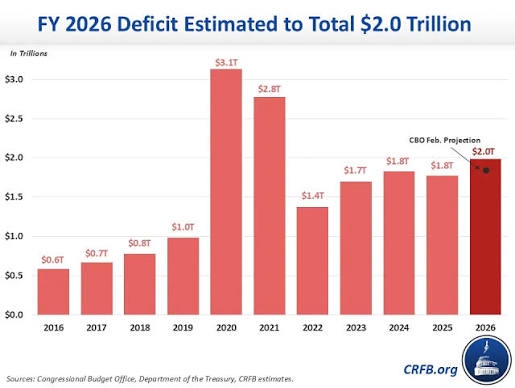
The US is running an annual deficit of around $2 trillion, adding further to its national debt, which is heading towards $41 trillion.
And the cost of servicing that debt continues to rise. Within a decade, annual interest payments alone are projected to reach $2.1 trillion.
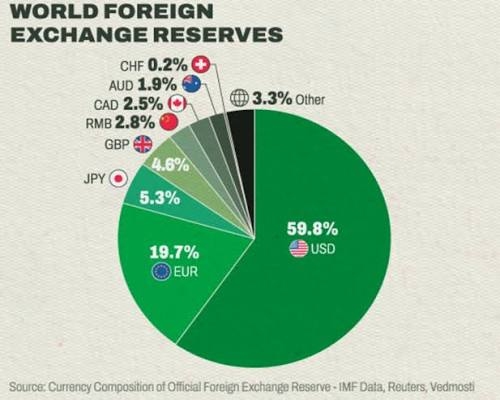
But the US is lucky, or it has been so far. That luck lies in the fact that the US Dollar has enjoyed global dominance, what a previous French President called an "exorbitant privilege". It can print as many Dollars as it wants. The world economy has depended on the US Dollar for more than 80 years. More than half of all world trade is invoiced in US Dollars.
When other countries run out of money or the lenders want to charge more, they face a serious threat. They have no choice but to cut their spending, or decline to pay their debts, or print more money. All of those have grave consequences. They can ask the International Monetary Fund (IMF) to lend something, but the IMF has shallow pockets. Its lending capacity is no more than $1 trillion.
Inflation is the key threat to fiat currencies. Printing more money devalues the purchasing power of that money. US consumer prices have risen by around 30% since 2020, eroding the purchasing power of the Dollar. Inflation has been driven by a combination of factors, including changes in money supply, government spending and economic conditions.
Does the 2% target still exist?
Central banks more or less everywhere aim to keep inflation at 2%/year. In the US inflation in September was 3.7%. This week saw the latest meeting of the FOMC (the Federal Open Market Committee), the body which sets US interest rates. As widely expected, the FOMC thought the US economy is currently strong, but few were surprised it didn't push rates higher.
The betting is that it will raise interest rates at its last meeting for this year, in December.
By then inflation may well be higher, given that so much uncontrollable global stress - wars, El Nino, slow economic growth almost everywhere outside of the US - persists. And in any case, if central banks were able to contain inflation to the 2%/year target, fiat money would lose almost 20% of its purchasing power over the next 10 years. That's hardly encouraging.
It seems eminently possible that the US may let inflation coast along above 2%, and thereby cut the real cost of its massive debt. Maybe the Federal Reserve's chairman, Kevin Warsh, is also looking to kick the can down the road. He's decided that one of the Fed's eight meetings next year will focus on monetary policy strategy rather than setting interest rates.
Huge debts, inflation dribbling along at 2% or X%, wars - all represent horrible yet indefinable threats. One thing is certain: the power of your fiat currency is inevitably destined to weaken. Gold has always been the long-term alternative to the steady debasement of fiat money. And gold with Glint gives the benefit of being able to use it as real money.
For UK clients: At Glint, we make every effort to demonstrate a balanced conversation between gold, silver, crypto and fiat currencies when it comes to purchasing power and, while we strongly believe that gold is the fairest and most reliable currency on the planet, we need to point out that it isn’t 100% risk free. While we have seen a steady increase over time, the value of gold can fall, which means that its purchasing power can also decline.
For US clients: Graphic representations of value are for illustrative purposes only. The Glint debt card is issued by Sutton Bank, member FDIC. The sale, purchase and storage of precious metals are offered by Glint and not Sutton Bank. Your investment in precious metals through Glint is
· Not insured by the FDIC.
· Not a deposit or other obligation of, or guaranteed by, Sutton Bank.
· Subject to investment risks, including the possible risk of loss of the principal amount invested.
All investments involve risk, including possible loss of principal. The value of precious metals is affected by many economic factors, including but not limited to the current market price, demand, perceived scarcity, and quality of the precious metal. Precious metals can increase or decrease in value. Past performance is not a guarantee of future results. As such, investing in precious metals may not be suitable for everyone.