What's China up to?
When the price drops, buy the dip. That's what gold buyers in China are doing.
The price, in Dollars, is now about 25% lower than its record high at the end of January. The price decline has been at a glacial pace.This gentle retreat has encouraged Chinese buyers. From January to the end of August China imported 1,141 tonnes of gold, 72% more than in all 2025. If it carries on, the same trend will see China importing about 1,700 tonnes this year - the highest amount in this decade.
The high price surge dented gold-for-jewelry demand but lower prices and a strong Chinese fiat currency have increased demand for gold-as-investment.
There's no secret as to why China is importing so much gold. The simple answer is - trust. Or the lack of it.
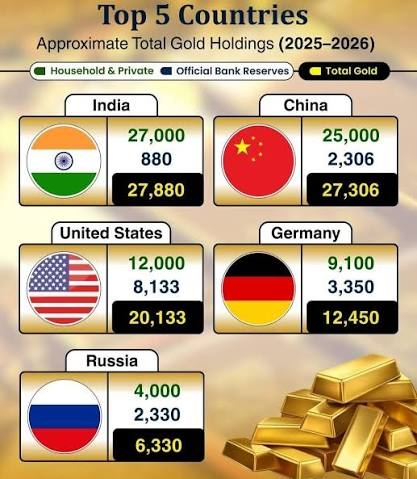
Central banks report how much gold they have. That gives them freedom to handle the truth as it suits. China's central bank gold reserves officially total 2,387 tonnes but independent observers put the real total much higher. That may be the case but China treats its official gold holdings as a state secret. Why? Another simple answer - "keep a cool head and maintain a low profile. Never take the lead - but aim to do something big" said Deng Xiaoping, China's leader during 1978-1989.
Doing something big is still China's aim.
Dribbling Dollars
The gold China has imported so far this year cost it almost $160 billion. That's a 65% increase on what it spent in 2025 to import 886 tonnes.
At the same time China, which is the third-biggest foreign holder of US government debt, is steadily downsizing how much US debt it holds. From a peak of more than $1.3 trillion in 2013 that debt has now fallen to $618 billion. Over 13 years that's a drop of about 52.5%.
China does not want US paper. It wants gold.
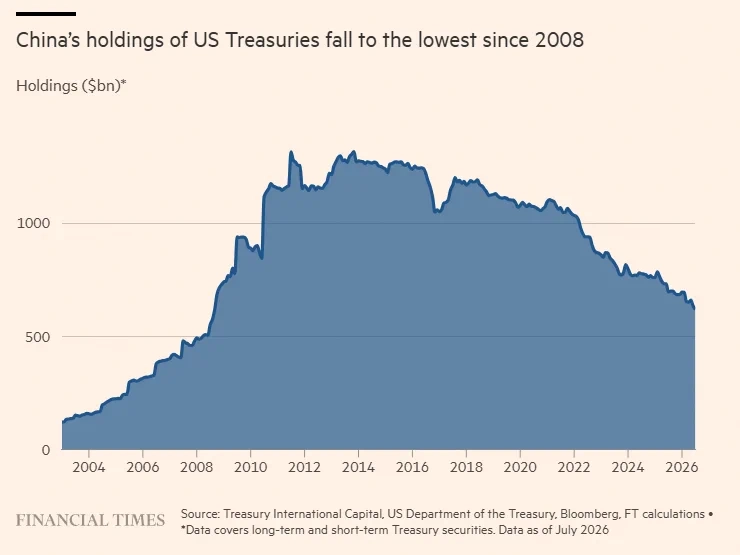
As well as China, India and Brazil reduced their US debt exposure. But that spurning of US paper is not universal. There's no evidence showing a generalized de-Dollarization. Many countries increased their holdings of US debt last year.
China is different. Many previously successful local investments are doing less well. China's property market boom has ended, with trillions lost, its stock prices are weak, and government bond yields are at their lowest for more than a year. In contrast, gold has glittered. Real assets - of which gold is the stellar - are what Chinese citizens want. Their fiat currency, the Yuan, is more a tool heavily controlled by the communist government than a trade-able global asset.
So while Chinese citizens want to own an asset that will hold its value, the Chinese government is thinking big - and perhaps domination of the world of gold is in its sight. Lisa Liu, managing director at Gold Mountains Asset Management, part of China's largest gold miner, Zijin Mining Group, has said China's central bank and private investors share the aim of diversifying their savings "towards an asset with no counter-party risk".
Avoiding risk
There is one good reason for flocking to gold. Avoiding risk.
Risk is top of the in-tray of all asset managers at the moment - or it should be. We're not talking of the risks involved in war with Iran or Ukraine, although Iran's war has destroyed its fiat currency, with $1 now fetching more than 2.5 million Rials., as opposed to 1.3 million rials before the war started.
The big risk is that the rising yields on US government bonds - today's yields have only been higher since 1900 during the inflationary 1960s to mid-2000s, and at the end of the First world war - raise borrowing costs for everyone. And bond yields are climbing in many countries.
Bond yields climb when bonds are sold. September saw a big sell-off of US government bonds. It's thought that Investors have been ditching them because of worries about persistent high inflation and massive government debts around the world. In the first half of 2026 gross global debt was $365 trillion, or 311% of gross domestic product (GDP). It's not just government borrowing which is rising. AI corporate bonds, necessary for the massive AI investment now going on, are also flooding the market. Some AI companies will fail, at the cost of those who lent them trillions.
But it is government debt which is the bigger risk, simply because it will just carry on growing. Inflation higher than the almost universally accepted target of 2%/year is now baked in.
Inflation is how governments 'silently' reduce the value of their debts. It's also punishing for bond holders and one reason why bonds are being sold. Long-term borrowing costs in the UK have now risen above 6%, far above the country's nominal economic growth rate.
China's gold hoarding is about avoiding risk. Gold gives it immunity in a world where trust in the US is steadily declining and the Dollar has become a geopolitical weapon. Gold has no counter-party risk and is politically neutral. Its purchases are a defense against further uncertainties, against unseen crisis.
Rudiger Dornbusch, the German-born economist who worked most of his life in the US, said of crises that "they take longer to arrive than you can possibly imagine but when they do come, they happen faster than you can possibly imagine."
China's gold buying gives us all the best lead in today's fragile world.
For UK clients: At Glint, we make every effort to demonstrate a balanced conversation between gold, silver, crypto and fiat currencies when it comes to purchasing power and, while we strongly believe that gold is the fairest and most reliable currency on the planet, we need to point out that it isn’t 100% risk free. While we have seen a steady increase over time, the value of gold can fall, which means that its purchasing power can also decline.
For US clients: Graphic representations of value are for illustrative purposes only. The Glint debit card is issued by Sutton Bank, member FDIC. The sale, purchase and storage of precious metals are offered by Glint and not Sutton Bank. Your investment in precious metals through Glint is
• Not insured by the FDIC.
• Not a deposit or other obligation of, or guaranteed by, Sutton Bank.
• Subject to investment risks, including the possible risk of loss of the principal amount invested.
All investments involve risk, including possible loss of principal. The value of precious metals is affected by many economic factors, including but not limited to the current market price, demand, perceived scarcity, and quality of the precious metal. Precious metals can increase or decrease in value. Past performance is not a guarantee of future results. As such, investing in precious metals may not be suitable for everyone.